Judith Dupont (1925-2025)
The Guardian of Ferenczian Memory
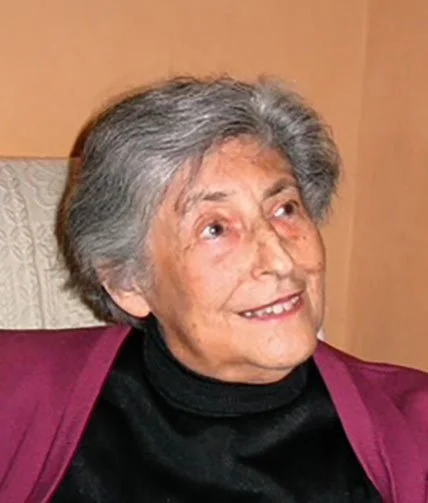
The guardian of Ferenczian memory left us on 1 October 2025. She was the last person in the world to have known Sándor Ferenczi. Some legacies choose you. Judith Dupont's was born of both chance and necessity—an interweaving of family ties with the history of psychoanalysis that would make her the great transmitter of Sándor Ferenczi's work.
Her grandmother had been analysed by Ferenczi for severe agoraphobia. Her aunt had married Michael Balint. Her mother had painted a portrait of the Hungarian psychoanalyst—a painting now lost, of which only a black-and-white photograph remains. Ferenczi was "almost like an uncle," she would say, "a member of the family." Of him, she kept the memory of a "kindly gentleman" who visited her grandparents. She was seven years old when he died in 1933. She still remembered the commotion in the house that day, the great emotion that had seized the adults. Ferenczi had not had time to grow old—he passed away before the age of sixty.
Rediscovering an outcast
When Judith Dupont received a copy of Thalassa from Michael Balint, she was captivated. She undertook to translate it into French. At that time, almost nothing of Ferenczi's existed in our language. His work suffered terribly from the poor reputation Ernest Jones had fashioned for him in his biography of Freud—Jones, who had himself been analysed by Ferenczi and seemed determined at all costs to conceal this fact. Freud himself had passed "very, very harsh and rather unfair" judgements on his former disciple, judgements he had somewhat revised thereafter. It took years after Ferenczi's death for people to realise that his final texts contained "valid ideas and not the ravings of a finished man," as some had claimed.
Judith Dupont took responsibility for this mistreated legacy. With the team at Le Coq-Héron, she methodically translated the complete works, the Clinical Diary—which had been thought unpublishable—and the vast correspondence with Freud. Sometimes a single sentence was discussed for an entire meeting: German, a more flexible language, resisted the passage into French. To translate was to enter into the intimacy of a mind, to recover an entire vanished world. A remarkable fact of intellectual history: it was France, before Germany, before the English-speaking world, that brought about Ferenczi's rediscovery. On Lacan, Judith Dupont held a nuanced view: "Lacan spoke of him, he read him, he spoke of him partly to criticise him, but intelligently—even if one doesn't agree with him." Laplanche too, Granoff "quite a bit." Something in Ferenczian thought "fitted better with the spirit of French psychoanalysis" than with the Anglo-Saxon world.
She was surprised, however, that Françoise Dolto had not really acknowledged Ferenczi. Through her interest in the child, Dolto might have been receptive to a text like "Confusion of Tongues Between Adults and the Child." But she had taken another path.
The anti-master
What did she retain of Ferenczi, she who had devoted her life to making his work known? First this: he was not a vain man. "He rather tended to doubt himself constantly, to always want to do better, never to be truly satisfied with what he did." The Clinical Diary bears witness to this permanent questioning of his own techniques, his own inventions. Each time he launched something, he would revisit it. This was, for Judith Dupont, the true scientific approach: never to think one has found something definitive. Ferenczi remained "at all times both student and practitioner." He never founded a school. "He was a free electron," she would say. And this question, almost rhetorical: "How can one found a school when one is in permanent evolution?" He did not ask people to fall in line with his ideas, but to think alongside him. Balint had followed a path inspired by Ferenczi, but very much his own. Ferenczi himself had written, in a late note, that Balint had "taken things up where he had fallen."
To be with
Ferenczi's essential contribution? Judith Dupont would answer without hesitation: "The importance of what happens in the analyst as well as in the patient. The importance of the relationship between the two. Empathy. Being able to be with."
What Ferenczi could not bear was the position of superiority, the didactic attitude of many analysts. For him, analysis was an exchange, an equal involvement. This demand made the profession "extraordinarily demanding," even "impossible"—but from time to time, there were "blessed moments."
And then this conviction that had earned him so much hostility: one must believe what people say. Not necessarily at face value, but "there is always something behind it." To hear everything, at least to try to hear what is real within it. The refusal to hear the trauma—on the part of the mother first, then of the analyst—itself constitutes a "second trauma."
The demand for sincerity, Judith Dupont would say: "One must say everything, but one must say nothing false."
Psychoanalysis will endure
Asked about contemporary attacks on psychoanalysis, Judith Dupont would reply with disarming serenity: "I would be tempted to say there is no point in responding to the attacks. Psychoanalysis exists. One can always attack it; it will exist nonetheless."
She spoke of this "foundation of knowledge and experience that works," whilst acknowledging that the discipline was evolving—"sometimes in good directions, sometimes in less good ones."
Shortly before her death, she had donated the entire Ferenczi archives to the Freud Museum in London. "I thought it was a good place," she said simply. Thus the circle of a tumultuous relationship was symbolically closed—Ferenczi reunited with Freud, under the sign no longer of conflict but of transmission. Judith Dupont spent more than half a century keeping alive a body of work that others had wanted to bury. Without her, Ferenczi would not have "become a classic," as she noted with quiet satisfaction. There are Ferenczi associations, Ferenczi seminars throughout the world—but no Ferenczian school in the sense that there is a Lacanian school. Ferenczi would doubtless have liked that. He who had never wanted disciples, only interlocutors capable of thinking for themselves.
Judith Dupont was one of those. The most faithful, perhaps, because the most free.
In tribute to Judith Dupont (1925–2025), translator and editor of the works of Sándor Ferenczi.
You can listen to the interview by Benoît Peeters on YouTube (automatic translation available) Our tribute is inspired mostly by its content.